
Giftedness Is Not a Mirage
A recent New York Magazine article, The Mirage of the Gifted Child, has sparked considerable discussion in gifted education circles by asking a provocative question: What if giftedness isn't real at all?
As someone who has spent years working with gifted learners, twice-exceptional students, families, and educators, I understand why the article resonates with many readers. It raises important concerns about equity, access, and the ways gifted identification has historically fallen short - and those concerns deserve thoughtful consideration.
Gifted identification has not always been equitable and access to gifted services varies widely from one district to another. Some students are identified early and receive the support they need, while others are overlooked for years. We should absolutely continue working to improve how we identify and serve advanced learners.
But acknowledging flaws in the system is very different from concluding that giftedness itself is a myth. In my experience, giftedness is not only real, it is often misunderstood. The challenge isn't whether gifted learners exist. The challenge is that many people are looking for giftedness in the wrong places. Too often, we expect gifted students to be high-achieving, compliant, and successful in every area. In reality, many gifted learners don't fit that stereotype at all.
The gifted students I have worked with over the years have taught me that giftedness is far more complex, diverse, and nuanced than many people realize.
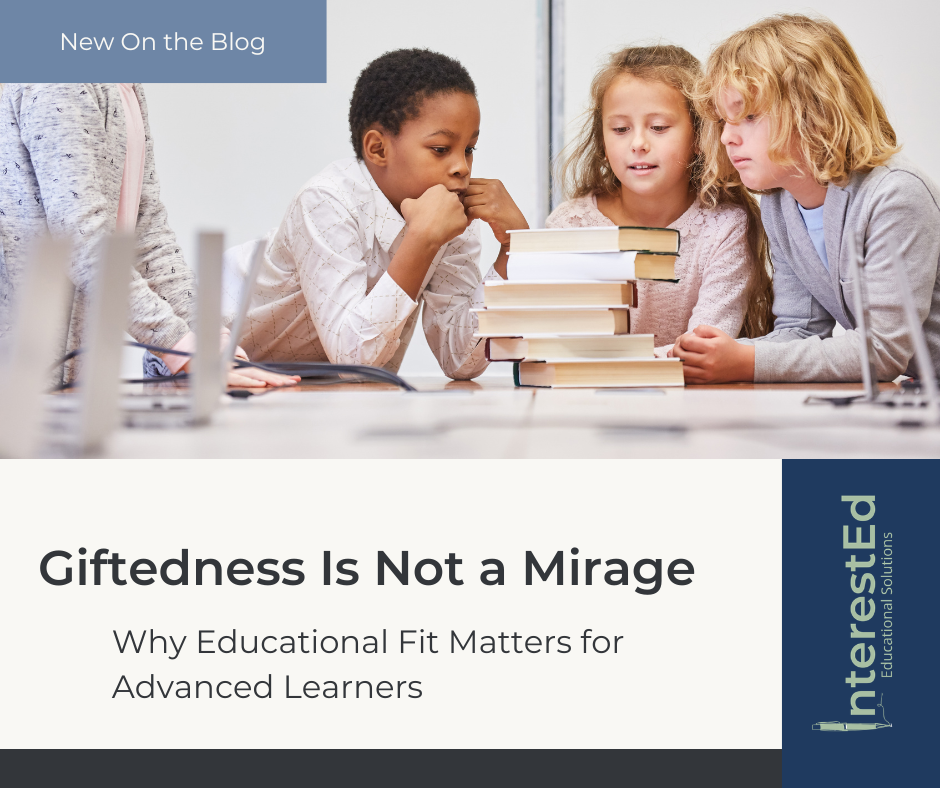
The Gifted Child Most People Never See
When many people hear the word "gifted," they picture a student who earns straight A's, finishes assignments quickly, raises their hand constantly, and excels in every subject. Sometimes that student exists, but many of the gifted students I work with look very different. Some struggle with organization, have ADHD or dyslexia, or are perfectionists who become so afraid of making mistakes that they avoid challenges altogether. Others spend their days daydreaming because they are bored, underachieve, or experience anxiety and frustration. Some have spent years hearing that they are lazy, careless, unmotivated, or difficult when the reality is that their educational needs have gone unmet. These students are one of the reasons I struggle with the idea that giftedness is merely a social construct or a label invented by adults. I've sat across from too many families who know something is different about their child but can't quite explain it, and I've watched students make connections that surprise adults, devour information, ask unusually complex questions, and demonstrate levels of curiosity and insight that simply aren't typical for their age. Those differences are real, even if they don't always show up in the ways we expect.
The Problem Isn't Giftedness. The Problem Is Identification.
One point from the article that deserves serious consideration is the role that opportunity plays in identification. Students from affluent families often have access to enrichment activities, educational experiences, tutors, books, travel opportunities, and advocacy that can increase their likelihood of being identified for gifted services, while students from historically marginalized backgrounds continue to be underrepresented in gifted programs across the country. This disparity is a problem, but inequitable identification does not mean giftedness doesn't exist; it means our systems need improvement. If a district fails to identify students with dyslexia, we wouldn't conclude that dyslexia is a myth—we would recognize that the identification process is flawed. The same logic applies here, and rather than abandoning gifted education, we should focus on finding better ways to identify students whose abilities might otherwise go unnoticed.
Gifted Education Is Not About Status
One of the things I wish more people understood is that gifted education should never be about prestige. It shouldn't be about proving that one child is smarter than another or about creating educational hierarchies. At its best, gifted education is about educational fit. Every student deserves to learn something new each day, to experience appropriate challenge, and to have opportunities to grow. For some students, grade-level curriculum provides exactly the right amount of challenge, but for others, it doesn't. Just as we provide additional support when students struggle to access the curriculum, we should also provide additional challenge when students have already mastered it. Neither approach is about favoritism; both are about meeting students where they are.
The Students Who Often Fall Through the Cracks
Perhaps the biggest issue I had with the article is that it largely overlooks twice-exceptional learners. Twice-exceptional students are both gifted and have a disability, such as ADHD, autism, dyslexia, or another learning difference. These students often don't fit anyone's expectations, as their giftedness can mask their disability and their disability can mask their giftedness, leaving them frequently misunderstood. These are the students who tell me they are bored but can't keep track of their assignments, who can discuss complex topics for an hour but struggle to write a paragraph, and who score exceptionally high in one area and unexpectedly low in another. They are also the students who hear, "You're so smart. Why aren't you trying harder?" For these learners, recognizing giftedness isn't about giving them a special label; it's about understanding who they are so we can better support them.
Excellence and Equity Can Coexist
Too often, conversations about gifted education become framed as a choice between excellence and equity. I don't believe we have to choose.In fact, I would argue that true equity requires us to recognize that students have different needs. Equity isn't about giving every student the exact same experience. It's about ensuring that every student receives what they need to learn, grow, and thrive. That includes students who need intervention. And it includes students who need greater challenge.
Both matter. Both deserve our attention.
Moving Forward
The New York Magazine article raises questions that are worth discussing. We should continue examining who gets identified, who gets overlooked, and how schools can create more equitable opportunities for advanced learning. But I don't believe the evidence supports the conclusion that giftedness is a mirage. The gifted students I have taught, coached, advocated for, and learned from over the years are not a mirage.
Their needs, strengths, and challenges are real.
The goal of gifted education should never be creating an elite group of students. The goal should be helping every learner, including those with advanced learning needs, receive an education that allows them to flourish.
That's not elitism - that's simply good teaching.
🌿 Laura
References
Arnold-Ratliff, K. (2026, June 15). The Mirage of the Gifted Child. New York Magazine.
Assouline, S. G., Colangelo, N., VanTassel-Baska, J., & Lupkowski-Shoplik, A. (2015). A Nation Empowered: Evidence Trumps the Excuses Holding Back America's Brightest Students. University of Iowa.
Colangelo, N., Assouline, S. G., & Gross, M. U. M. (2004). A Nation Deceived: How Schools Hold Back America's Brightest Students. The Templeton National Report on Acceleration.
National Association for Gifted Children. (2024). Equity and Access Position Statement.
Renzulli, J. S. (1978). What Makes Giftedness? Reexamining a Definition. Phi Delta Kappan, 60(3), 180-184.
Silverman, L. K. (2013). Giftedness 101. Springer Publishing.
Subotnik, R. F., Olszewski-Kubilius, P., & Worrell, F. C. (2011). Rethinking Giftedness and Gifted Education: A Proposed Direction Forward Based on Psychological Science. Psychological Science in the Public Interest, 12(1), 3-54.
Read More:


The school year is underway, and there’s a lot happening at InterestEd. This September issue includes practical classroom ideas, updates on the Whole Learner Instructional Decision Framework, gifted education and professional learning news, recent writing, resources, and a look at what I’ve been working on this fall.