
20 Words to Know in Gifted Education
When we talk about gifted education, the words we use matter. They shape how we see students, how we design learning experiences, and how we advocate for their needs.
For families and educators alike, understanding these terms can bridge the gap between what giftedness is and how we nurture it. Gifted learners don’t all look or learn the same. Some are deeply creative, others analytical. Some move through material quickly, while others linger thoughtfully on ideas that fascinate them.
This glossary is for anyone who wants to understand the language behind gifted education. These twenty key ideas form the foundation of how gifted children grow, think, and experience the world.
General Terms
Giftedness
Giftedness refers to advanced ability or potential in one or more areas—academic, creative, artistic, or leadership. It is not about being better than others; it is about learning and thinking in ways that differ from typical development. In gifted education, giftedness means a need for differentiated learning experiences that match a child’s pace, curiosity, and depth. A common misunderstanding is that gifted students are simply high achievers. High-achieving students often excel because they work hard, follow directions, and strive to meet expectations. Gifted students, on the other hand, tend to question, explore, and think in unconventional ways. Their curiosity and intensity often lead them to seek deeper understanding rather than perfect grades. Recognizing this difference helps educators and families support both groups appropriately.

Example: A second grader who builds a working solar system model after reading about planets isn’t just ahead. She’s demonstrating conceptual understanding and self-directed learning. Her giftedness shows up in her questions, not just her test scores.
Twice Exceptional (2e)
A twice exceptional student is both gifted and has a learning difference, such as ADHD, dyslexia, or autism. These students often show remarkable insight in one area and genuine struggle in another. Recognizing and supporting 2e learners requires a balanced approach of honoring their strengths while addressing their needs. 2e students frequently experience frustration in traditional settings where their challenges may overshadow their abilities. True support comes through a combination of enrichment and accommodation - offering opportunities for challenge, choice, and creativity while also providing tools and flexibility to navigate their learning differences.
Example: A middle schooler who solves complex math problems in his head struggles to show his work on paper because of dysgraphia. When he’s allowed to explain his reasoning aloud or record it digitally, his advanced thinking becomes clear. His learning difference doesn’t hide his giftedness, but it does change how it shines.
Asynchronous Development
“Understanding asynchronous development helps adults see these moments not as misbehavior but as natural parts of a gifted child’s growth.”
Asynchronous development describes the uneven growth of gifted children across intellectual, emotional, and social domains. It’s why a child might debate global issues one moment and have a meltdown over a broken pencil the next. Their intellect and emotional regulation don’t always mature at the same rate. Understanding asynchronous development helps adults see these moments not as misbehavior but as natural parts of a gifted child’s growth. Supporting them means nurturing both the advanced and the developing sides and offering intellectual challenge while teaching coping and communication skills.
Example: A nine-year-old who reads Shakespeare but struggles to make friends isn’t immature—she’s developing on two different timelines. Recognizing that helps adults guide her with patience and empathy.
Instructional Approaches
Once we understand how gifted learners think, the next step is knowing how to teach them. These approaches keep learning challenging, meaningful, and developmentally appropriate.
Differentiation
Differentiation means adjusting instruction so that every student gets what they need. This does not mean more work, but better-fit work. For gifted learners, differentiation involves providing opportunities for depth, complexity, and creative or abstract thinking rather than simple acceleration through content. It is about designing learning that meets students where they are and stretches them forward. In a differentiated classroom, the teacher acts as a facilitator of growth, offering multiple pathways to learning. This might include tiered assignments, open-ended projects, or flexible grouping based on interest or readiness. The goal is engagement through meaningful challenge—helping gifted students explore ideas that match their curiosity and capacity.
Example: In a history unit, while the class studies explorers, a gifted student might research the ethical implications of colonization and present findings through a podcast. Differentiation allows the student to dig deeper into moral and cultural perspectives instead of simply completing extra worksheets.
“Well-planned acceleration supports both academic growth and emotional well-being when guided by readiness rather than age.”
Acceleration
Acceleration allows students to move through material faster than traditional pacing. This can be through grade skipping, subject advancement, compacted curriculum, or early access to higher-level coursework. The purpose is not to push a child ahead prematurely, but to ensure that learning remains appropriately challenging and engaging. For many gifted students, acceleration is essential to prevent boredom and underachievement. When instruction matches a student’s readiness level, they can stay motivated and connected to learning rather than disengaging from repetition. Research consistently shows that well-planned acceleration supports both academic growth and emotional well-being when guided by readiness rather than age.
Example: A middle schooler who completes Algebra early might take high school math online while staying with peers for other subjects, balancing academic growth with social connection. This approach honors both cognitive and emotional development.
Enrichment
Enrichment expands learning beyond the standard curriculum by deepening understanding, encouraging creativity, and connecting learning to real-world contexts. It is not “extra” work, but is expansive work that helps students explore their interests, apply their knowledge, and make interdisciplinary connections. Effective enrichment often includes project-based learning, mentorships, interest-driven investigations, and opportunities for authentic problem solving. It invites students to take ownership of their ideas, to inquire, and to create. For gifted learners, enrichment transforms curiosity into contribution and helps them see how their passions connect to meaningful purpose.
Example: During an enrichment project, a student fascinated by marine life designs an underwater ecosystem model using recycled materials, blending science, art, and sustainability. Through this experience, she develops not just content knowledge but creative problem-solving skills and ecological awareness.
Universal Design for Learning (UDL)
Universal Design for Learning is a flexible teaching framework that removes barriers before they appear. It offers multiple ways for students to access content, engage with material, and demonstrate understanding. UDL benefits all learners, including gifted students, by promoting autonomy and creativity. It allows students to express their ideas through choice by showing mastery in ways that match their strengths.
Example: In a science unit, students might choose to demonstrate learning through a written report, digital model, or short video. For gifted learners, this flexibility fosters ownership and innovation.
**Although the terms differentiation, enrichment, and Universal Design for Learning (UDL) are often used interchangeably, they serve distinct purposes within gifted education. Differentiation tailors instruction to meet a student’s readiness level, interest, and learning pace—adjusting the depth and complexity of content. Enrichment extends learning beyond the standard curriculum, offering breadth and creativity through independent exploration, authentic projects, or interdisciplinary connections. UDL provides the framework that ensures all students can access and express learning in multiple ways. When used together, these approaches create a responsive environment where gifted learners are both challenged and supported.
Thinking and Learning
Gifted learners often think in nonlinear, abstract, or deeply reflective ways. These concepts describe how their minds approach complexity and meaning.
Cognitive Complexity
Cognitive complexity refers to how deeply a student engages with ideas—analyzing, synthesizing, and connecting concepts rather than memorizing. Gifted learners thrive when challenged to interpret, question, and apply knowledge in new ways. Classrooms that embrace cognitive complexity encourage thinking beyond surface-level understanding. This includes asking “why” and “how” questions, exploring multiple perspectives, and making connections across disciplines.
Example: Instead of naming the planets, a student asks, “Why do some rotate differently?” That question shows curiosity rooted in understanding, not recall.
“Gifted learners often use divergent thinking naturally, seeing patterns, possibilities, and connections that others may miss. ”
Divergent Thinking
Divergent thinking is the ability to generate multiple ideas or solutions to a single problem. It’s creative problem-solving, which is the foundation of innovation and original thought. Gifted learners often use divergent thinking naturally, seeing patterns, possibilities, and connections that others may miss. Supporting this skill means creating learning spaces where exploration, risk-taking, and imagination are valued as much as accuracy.
Example: When asked how to improve the school playground, one student suggests a quiet reading nook, another designs an obstacle course. Divergent thinkers expand what’s possible, inviting new ways to see the world.
Metacognition
Metacognition means “thinking about thinking.” It’s the process of reflecting on how one learns, solves problems, and makes decisions. For gifted students, developing metacognitive skills builds self-awareness, resilience, and ownership of learning. Teaching metacognition involves modeling reflection and helping students plan, monitor, and evaluate their approaches to tasks. It empowers them to understand their strengths, notice patterns, and make intentional choices about how they learn best.
Example: After struggling with a project, a student notes, “I do better when I draw my ideas first.” That reflection leads to stronger independence and problem-solving in future work.
Executive Functioning
Executive functioning encompasses organization, planning, memory, and self-control. Many gifted students have advanced ideas but need support in managing them. Their minds may race ahead of their systems. Helping gifted learners build executive functioning skills means teaching strategies like visual reminders, planners, checklists, and structured routines. These tools help turn vision into follow-through and inspiration into results.
Example: A student invents a board game about physics, but forgets to bring the pieces. Teaching organization strategies helps bridge the gap between creativity and completion.
Mindset and Motivation
Gifted learners often wrestle with expectations- both their own and others’ expectations of them. Understanding mindset helps them navigate challenge, perfectionism, and resilience.
Fixed Mindset
A fixed mindset is the belief that ability is static: you’re either good at something or you’re not. For gifted students, this can lead to fear of failure or avoidance of challenge, as mistakes feel like threats to their identity as “smart.” Encouraging reflection and normalizing struggle helps shift this pattern so students see learning as a process rather than a performance.
Example: A student who has always excelled in reading refuses to participate in a creative writing activity, saying, “I’m just not good at stories.” By gently modeling revision and showing that even strong writers draft and edit, the teacher helps the student see that effort, not perfection, leads to growth.
Growth Mindset
“For gifted students, this mindset allows them to take intellectual risks without fear of losing status or identity. ”
A growth mindset is the belief that intelligence develops through effort, reflection, and learning from mistakes. For gifted students, this mindset allows them to take intellectual risks without fear of losing status or identity. When adults praise curiosity, persistence, and creative thinking rather than perfect outcomes, students become more willing to stretch beyond what they already know.
Example: When a perfectionistic student struggles with math, a teacher reminds them, “Your brain is growing every time you stretch like this.” Over time, that shift builds resilience.
Perfectionism
Perfectionism can drive excellence, but it can also lead to paralysis. Many gifted learners hold themselves to impossible standards and tie self-worth to achievement. Healthy perfectionism becomes harmful when fear of mistakes limits creativity or joy. Supporting gifted students means reframing mistakes as part of growth and emphasizing progress over performance. Modeling vulnerability as adults also helps students see that even experts learn through trial and error.
Example: Example: A young artist throws away several sketches, unhappy that none look exactly as she imagined. When encouraged to keep each version as part of her process, she begins to see mistakes as milestones on the path to mastery.
Underachievement
Underachievement occurs when performance doesn’t match potential. It’s rarely due to laziness; more often to disconnection, lack of challenge, or fear of failure. Re-engaging underachieving gifted learners means finding relevance, autonomy, and purpose in learning. When they see meaning in their work, motivation returns.
Example: A student who finishes work early but doodles instead of participating may need more meaningful challenges to re-engage.
“Motivation grows when students feel both supported and stretched.”
Social Emotional Learning
Giftedness involves both the mind and the heart. These ideas show how emotional understanding and autonomy shape learning.
Social Emotional Learning (SEL)
Social Emotional Learning helps students recognize and manage emotions, build empathy, and develop strong relationships. Gifted students often experience intense feelings such as compassion, frustration, joy, and injustice at deep levels. Teaching SEL in gifted education provides language and strategies for managing those emotions and connecting with others. It validates their inner world while equipping them for collaboration and resilience.
Example: A child who cries after reading about injustice isn’t overreacting; they’re demonstrating empathy and moral reasoning beyond their years.
Autonomy
Autonomy means having meaningful choice and voice in learning. Providing autonomy means trusting students to make decisions, explore interests, and take responsibility for their learning journey. It builds motivation, confidence, and independence, skills that last long beyond school.
Example: Allowing a student to choose between creating a short film or writing a report on climate change can spark pride and engagement while honoring individual strengths.
Creative Expression
Creative expression allows students to turn ideas and emotions into something tangible, like art, writing, design, invention, or performance. For gifted learners, it’s often not just self-expression but a form of problem-solving and meaning-making. Encouraging creativity validates emotional depth and nurtures purpose. It also supports the connection between thought and feeling, intellect and imagination.
Example: A student frustrated by social issues channels that energy into composing a song that captures her feelings, finding both voice and agency in the process.
Equity and Inclusion
Gifted education must include all gifted students - those from every background, culture, language, and learning profile. Equity ensures that talent is recognized and nurtured wherever it exists.
Equity in Identification
Equity in identification ensures that gifted programs reflect the diversity of all communities. This requires using multiple measures that are both qualitative and quantitative to find students whose potential may not show through traditional testing, and recognizing that brilliance expresses itself in many forms. By broadening how we look for giftedness, we open doors for students who have long been overlooked.
Example: A student who excels in problem-solving but struggles with English may reveal gifted potential through nonverbal or performance-based assessments instead of written tests.
“Culturally responsive identification recognizes that brilliance expresses itself in many forms. ”
Cultural Responsiveness
Cultural responsiveness values a student’s background, language, and lived experiences as assets rather than barriers. Teaching through that lens makes gifted education more inclusive, relevant, and empowering. When instruction connects to identity, students feel seen and valued, and their unique perspectives become sources of strength and creativity.
Example: Inviting students to explore heroes from their own cultures in a leadership project validates identity while developing critical thinking.
Final Thoughts
Language shapes perspective. When we understand the terms that describe gifted learning, we begin to see the whole child and not just ability, but curiosity, creativity, and emotion.
Giftedness doesn’t fit neatly into a label, but words like these help us communicate, advocate, and connect. Whether you’re a parent navigating new territory or an educator shaping learning experiences, this shared language opens doors to understanding and reminds us that every gifted learner deserves to be seen, challenged, and supported.
Understanding these terms is only the beginning. To support families and educators even further, I created a supplemental resource called the Foundations of Giftedness Glossary. It brings all twenty concepts together in one place and pairs each definition with clear examples, practical explanations, and easy-to-read summaries. This printable guide is perfect for teachers to share with families during conferences, meetings, or the identification process, and it offers parents a simple way to make sense of the language they encounter in gifted education. Whether you keep it at your desk as a quick reference or use it to start deeper conversations about student needs, this glossary is designed to help everyone speak the same language as we work together to nurture gifted learners.
Resource: Download the Foundations of Giftedness Glossary PDF to keep on hand or share with families and colleagues.
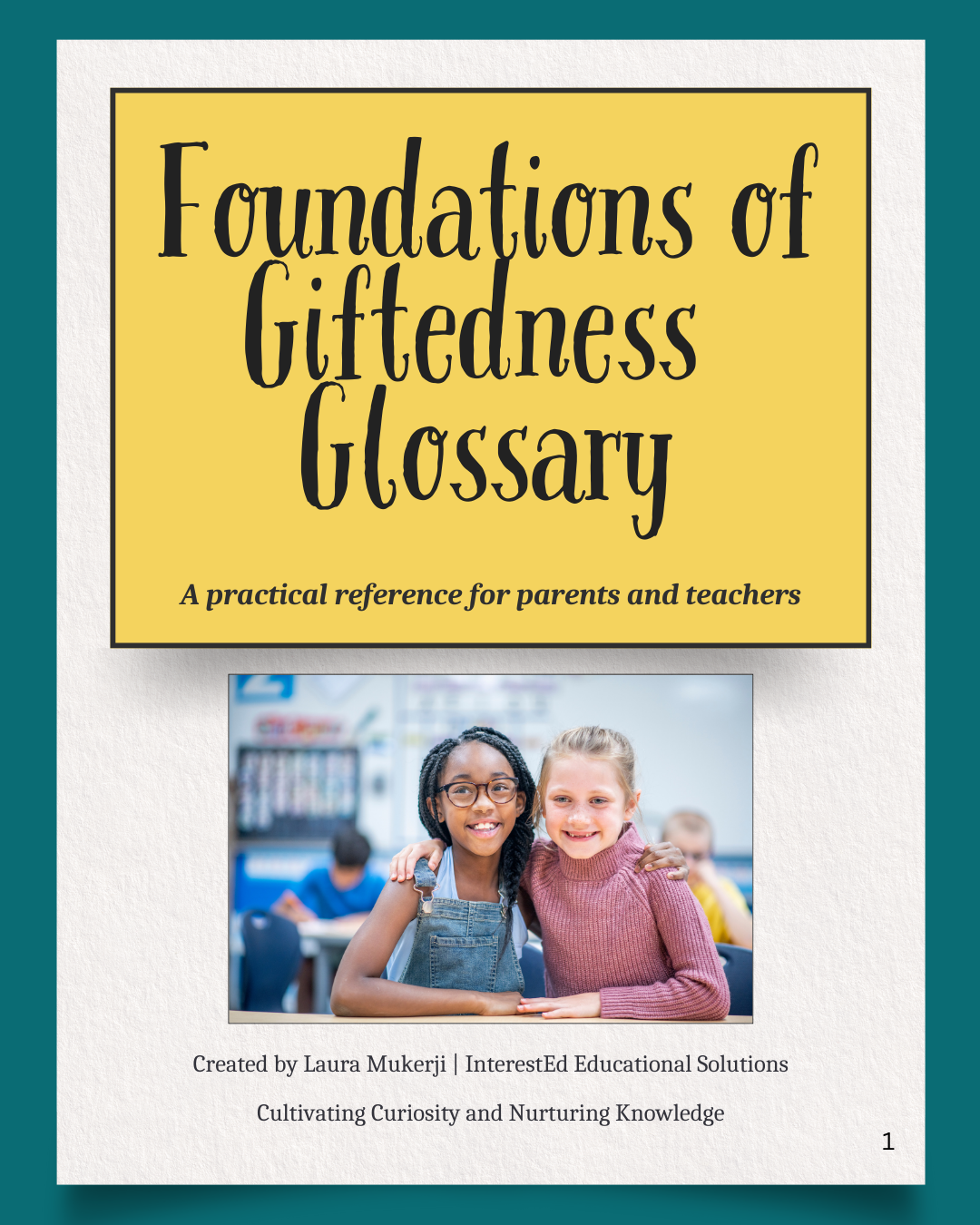
A clear, parent-friendly glossary explaining 20 key gifted education terms with examples. Printable PDF for families, teachers, and homeschoolers.


The school year is underway, and there’s a lot happening at InterestEd. This September issue includes practical classroom ideas, updates on the Whole Learner Instructional Decision Framework, gifted education and professional learning news, recent writing, resources, and a look at what I’ve been working on this fall.